How to Avoid Overeating on Thanksgiving Without Skipping Your Favorite Foods
Thanksgiving is often centered around food, and it is normal to eat differently than you would on an ordinary day. You do not need to skip your favorite dishes or approach the meal like a strict diet.
If your goal is to avoid feeling overly full, uncomfortable, or sluggish afterward, a few simple strategies can make a difference. Eating normally earlier in the day, starting with a reasonable portion, slowing down, and giving yourself time before going back for seconds can help you enjoy the foods you want without turning Thanksgiving dinner into an eating challenge.
Don’t Skip Meals to “Save Room” for Thanksgiving Dinner
It may seem logical to eat very little before a large Thanksgiving meal, but arriving at dinner extremely hungry can make it harder to recognize when you are comfortably full.
Instead, eat relatively normally earlier in the day.
Depending on when Thanksgiving dinner is served, that might mean having breakfast and a lighter lunch or snack rather than fasting for most of the day.
The goal is not to fill up before Thanksgiving dinner. It is simply to avoid becoming so hungry that you feel rushed to eat everything at once.
Decide What You Actually Want Before Filling Your Plate
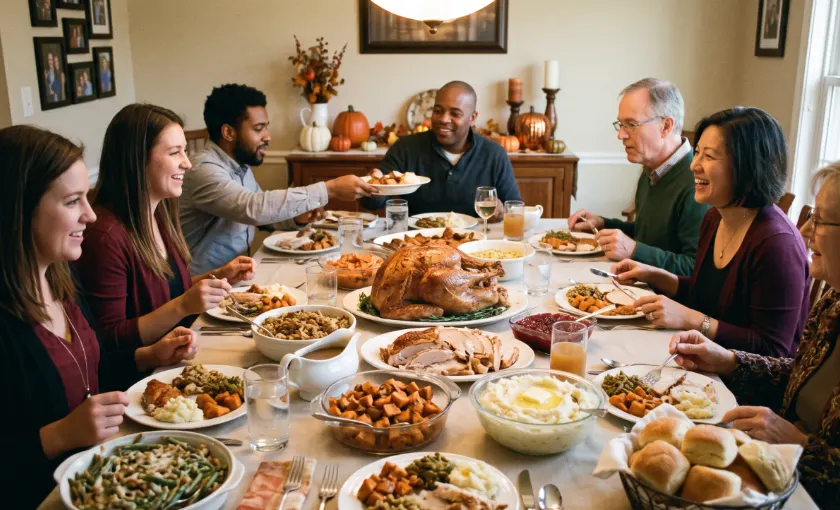
Thanksgiving tables can have a lot of options: turkey, stuffing, mashed potatoes, rolls, casseroles, vegetables, cranberry sauce, and several desserts.
Before serving yourself, take a moment to look at what is available.
Choose the foods you genuinely look forward to rather than automatically putting some of everything on your plate.
You can always go back for something you missed.
This can be especially helpful at buffets or large family gatherings where the number of choices makes it easy to take more food than you intended.
Start With a Comfortable Portion
You do not have to make your Thanksgiving plate unusually small.
Instead, start with an amount that looks satisfying without assuming you need to fit every food onto the first plate.
Including protein, vegetables, and the Thanksgiving dishes you enjoy can create a balanced meal without making the holiday feel restrictive.
Starting with a moderate portion also gives you an opportunity to decide whether you are actually still hungry before having more.
Eat Slowly Enough to Notice When You’re Getting Full
Thanksgiving meals are easy to eat quickly, especially when there is a large amount of food in front of you.
Slowing down can make it easier to notice the transition from hungry to satisfied.
Try putting your fork down periodically, talking with people at the table, and taking time to enjoy the food rather than rushing toward a completely empty plate.
We recommend eating slowly and allowing time before deciding whether you want seconds.
Wait Before Going Back for Seconds
Finishing your first plate does not necessarily mean you need another one immediately.
Give yourself a little time.
You may realize that you are comfortably satisfied once the meal has had time to settle. If you are still hungry, you can have more.
The goal is not to create a rule that says “no seconds.” It is to make the decision based on hunger rather than habit or simply because more food is available.
You Don’t Have to Eat Everything at Once
Thanksgiving leftovers are part of the holiday.
If there is another dish or dessert you want but you already feel comfortably full, save it for later.
There is no nutritional advantage to squeezing every favorite food into a single meal simply because it is Thanksgiving.
Your favorite holiday foods can still be enjoyed and that taking something home for later can be an alternative to continuing to eat after you are full.
Be Careful With the “I Already Blew It” Mindset
Eating more than usual at one Thanksgiving dinner does not undo your health goals.
One large meal is very different from your usual eating pattern.
Thinking of Thanksgiving as a “cheat day” can sometimes encourage the idea that you should eat as much as possible because you plan to start over tomorrow.
A more useful approach is simpler: enjoy the foods you want, notice when you are becoming full, and return to your normal routine afterward.
There is no need to compensate by skipping meals the next day.
What If You Already Feel Too Full?
Sometimes you realize you have eaten too much only after the meal is over.
If that happens, give your body time to digest.
Avoid immediately eating more simply because dessert is being served. You can save dessert for later if you want it.
A gentle walk after dinner may also feel more comfortable than remaining completely inactive after a large meal.
The important point is not to punish yourself for overeating. Thanksgiving is one meal, and occasional overeating happens.
Why Is It So Easy to Overeat at Thanksgiving?
Thanksgiving combines several things that can make eating beyond comfortable fullness easier:
- More food choices than usual
- Larger portions
- Foods you may only eat once or twice a year
- Long meals and social gatherings
- Snacks and appetizers before dinner
- Desserts immediately after the meal
- The expectation that Thanksgiving is supposed to involve eating a lot
That does not mean you need perfect portion control.
It simply means recognizing that the environment is different from an ordinary meal can help you make more deliberate choices.
Is Portion Control Enough for Long-Term Weight Loss?
Holiday meal strategies can help you feel more comfortable after Thanksgiving dinner, but they should not be confused with long-term treatment for obesity.
Weight management is more complicated than simply deciding to eat smaller portions.
Genetics, metabolism, hormones, medications, medical conditions, environment, sleep, activity, and eating patterns can all influence body weight. For some people, nutrition and lifestyle changes produce meaningful long-term results. Others continue to struggle with obesity despite repeated attempts at weight loss.
A sustainable eating pattern is generally more useful than repeatedly moving between strict diets and periods of overeating. NIDDK recommends choosing eating patterns that can be maintained over time rather than relying on short-term approaches.
For people with obesity who have not achieved sufficient or durable results with nonsurgical approaches, additional treatments may be appropriate.
When Bariatric Surgery May Be a Long-Term Option
Metabolic and bariatric surgery is not a way to avoid thinking about nutrition, and it is not a solution for eating too much at Thanksgiving.
It is a medical treatment for obesity.
Procedures such as gastric sleeve and gastric bypass change the digestive system in ways that can reduce food intake and influence appetite, metabolism, and weight regulation.
For appropriately selected patients, bariatric surgery can produce substantial long-term weight loss and improve obesity-related conditions such as type 2 diabetes, high blood pressure, sleep apnea, unhealthy cholesterol levels, and joint pain.
Current ASMBS/IFSO guidelines recommend metabolic and bariatric surgery for people with a BMI of 35 or higher regardless of whether obesity-related conditions are present. Surgery should also be considered in some people with metabolic disease and a BMI between 30 and 34.9. Individual eligibility still requires medical evaluation.
Bariatric Surgery Is a Tool, Not Another Short-Term Diet
If every holiday, vacation, or special occasion feels like another round of trying to “be good,” restricting food, overeating, and then starting another diet, it may be worth looking at the bigger picture.
For people who meet medical criteria, bariatric surgery can be one part of a comprehensive approach to treating obesity rather than another temporary diet.
Surgery does not eliminate the need for healthy eating. Patients still need to make long-term nutrition and lifestyle changes and continue medical follow-up after surgery. However, bariatric surgery can provide a physiological tool that supports weight loss and weight management rather than relying on willpower alone.
The right approach depends on your health history, weight, previous treatment attempts, goals, and the type of procedure being considered.
Talk With BASS Bariatric Surgery About Your Weight-Loss Options
Thanksgiving dinner should not require a perfect eating plan.
Eating normally before the meal, choosing the foods you actually want, slowing down, and stopping when you feel comfortably satisfied can help you enjoy the holiday without feeling overly full afterward.
But if managing your weight has become a constant cycle of dieting, regaining weight, and starting over, one holiday meal may not be the real issue.
For eligible patients with obesity, metabolic and bariatric surgery may provide a more durable treatment option.
The surgeons at BASS Bariatric Surgery Center can help you understand whether bariatric surgery may be appropriate for you and discuss procedures such as gastric sleeve and gastric bypass based on your health and long-term goals.